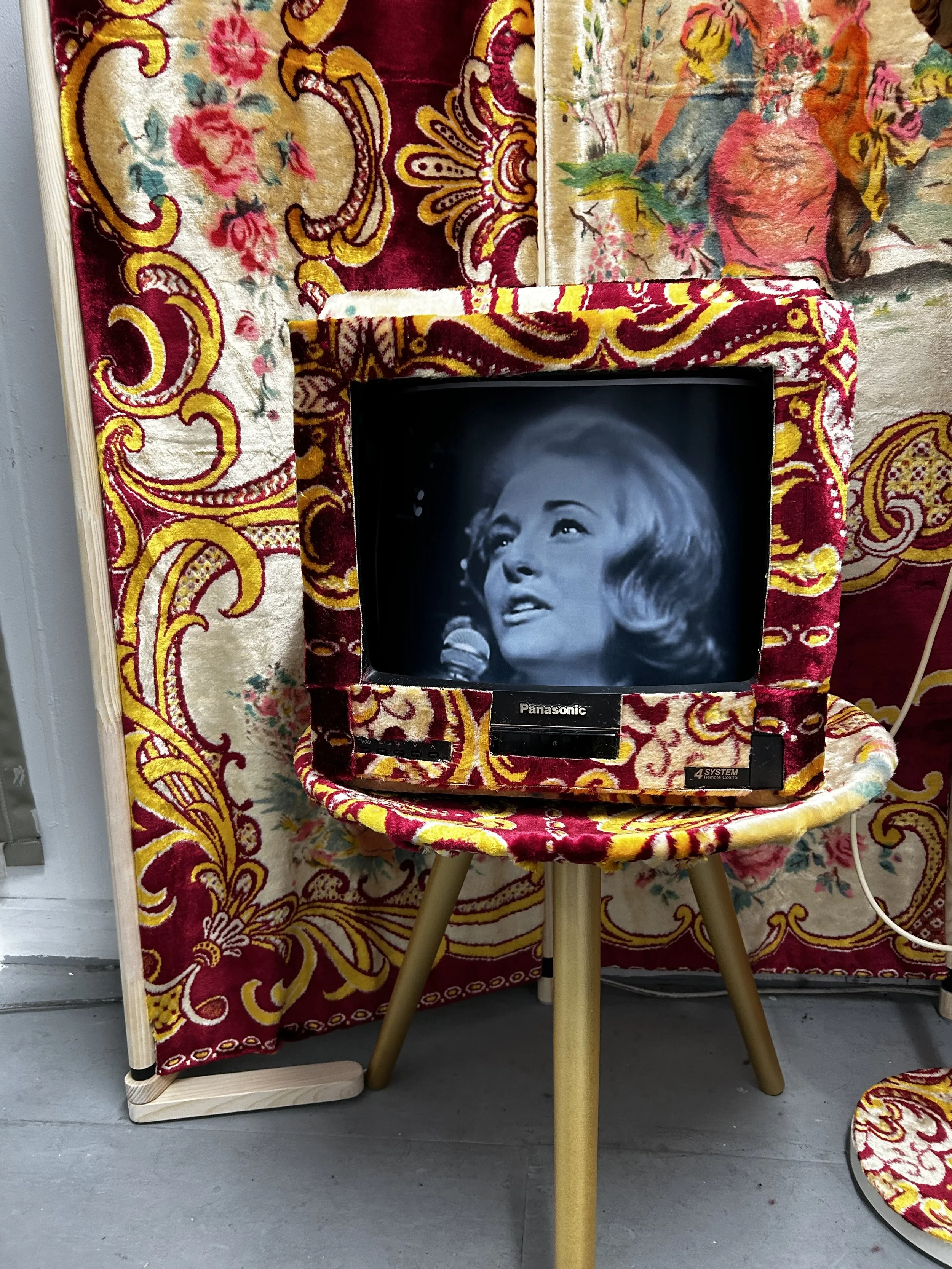
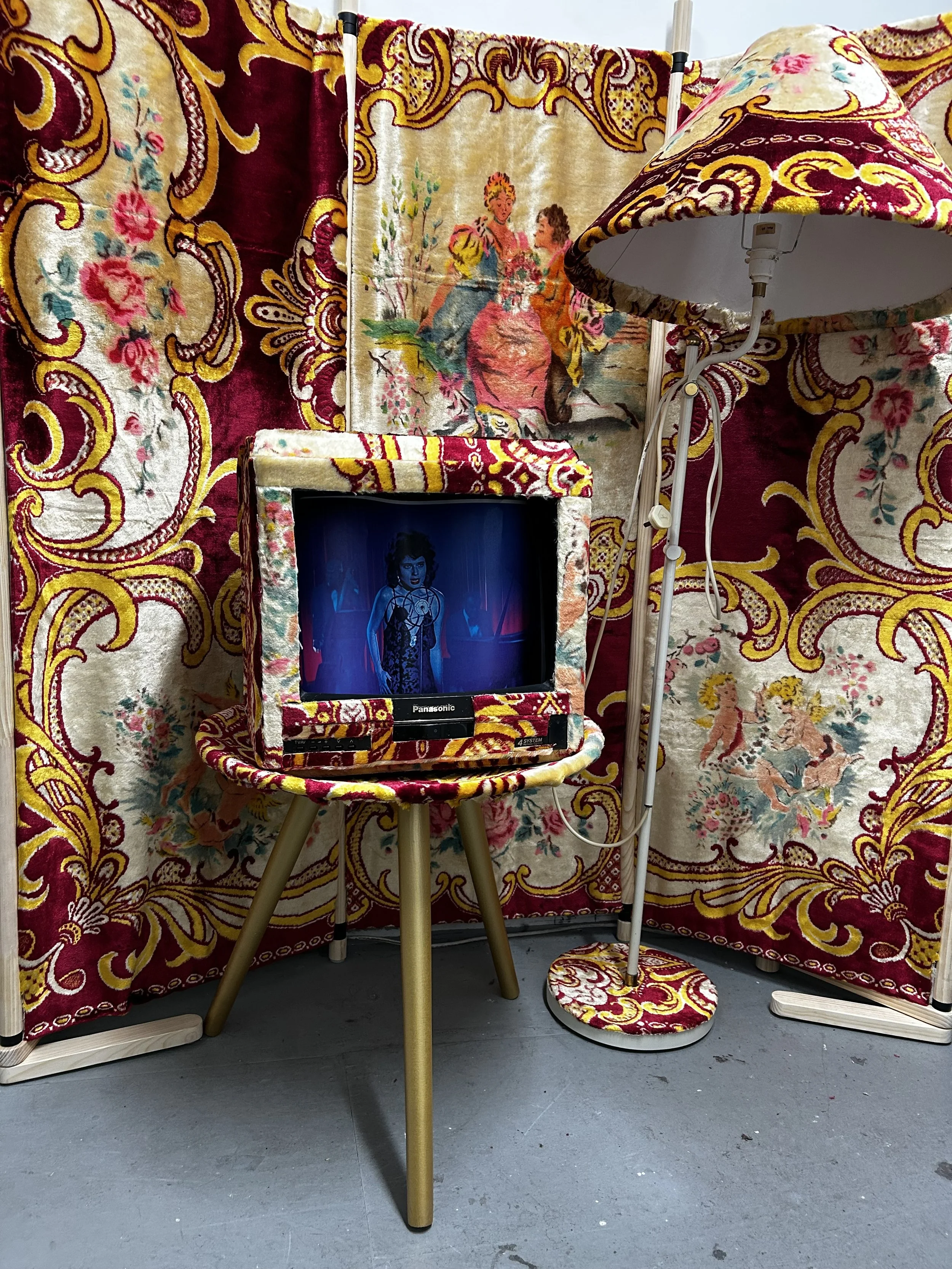
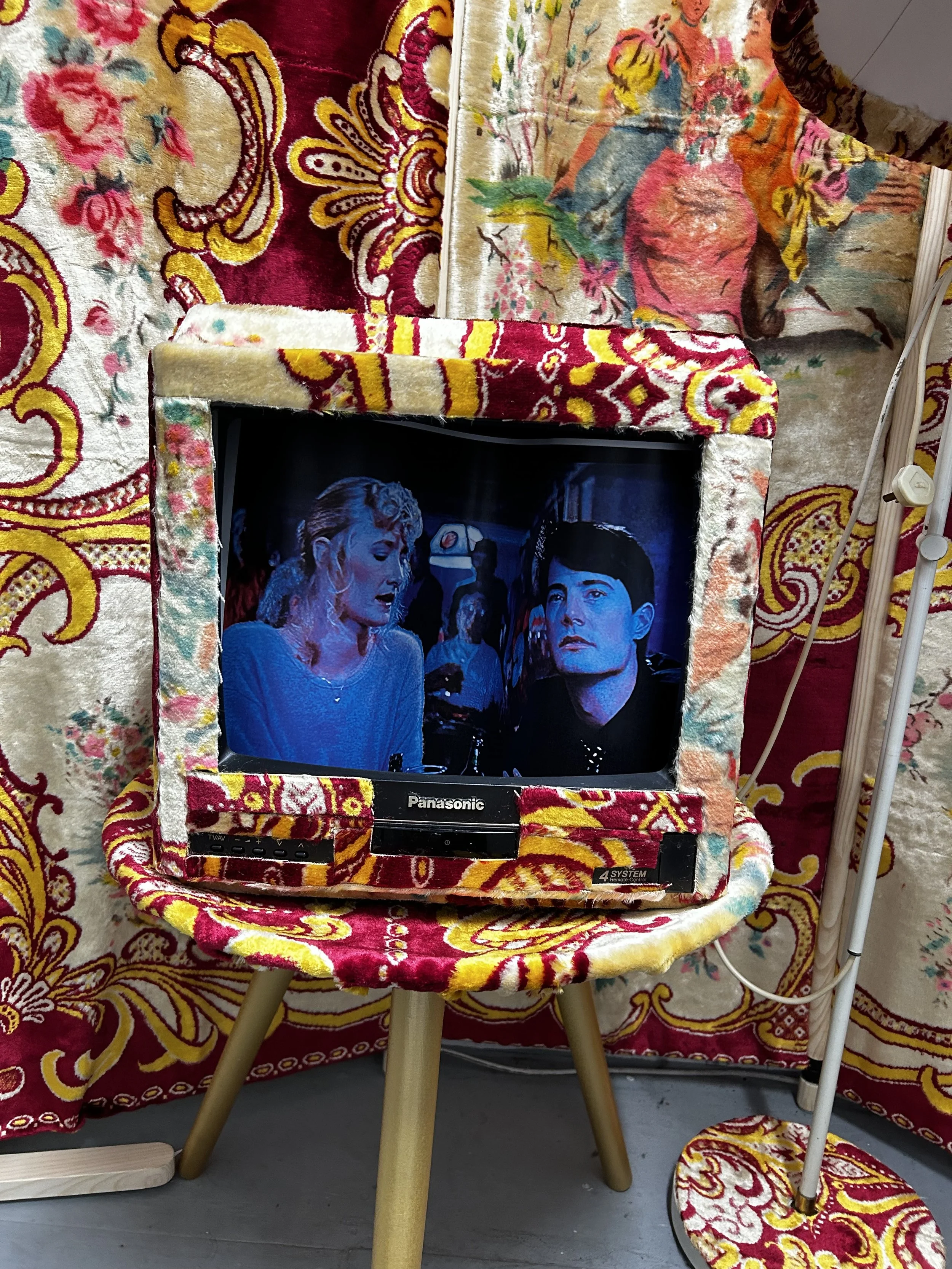
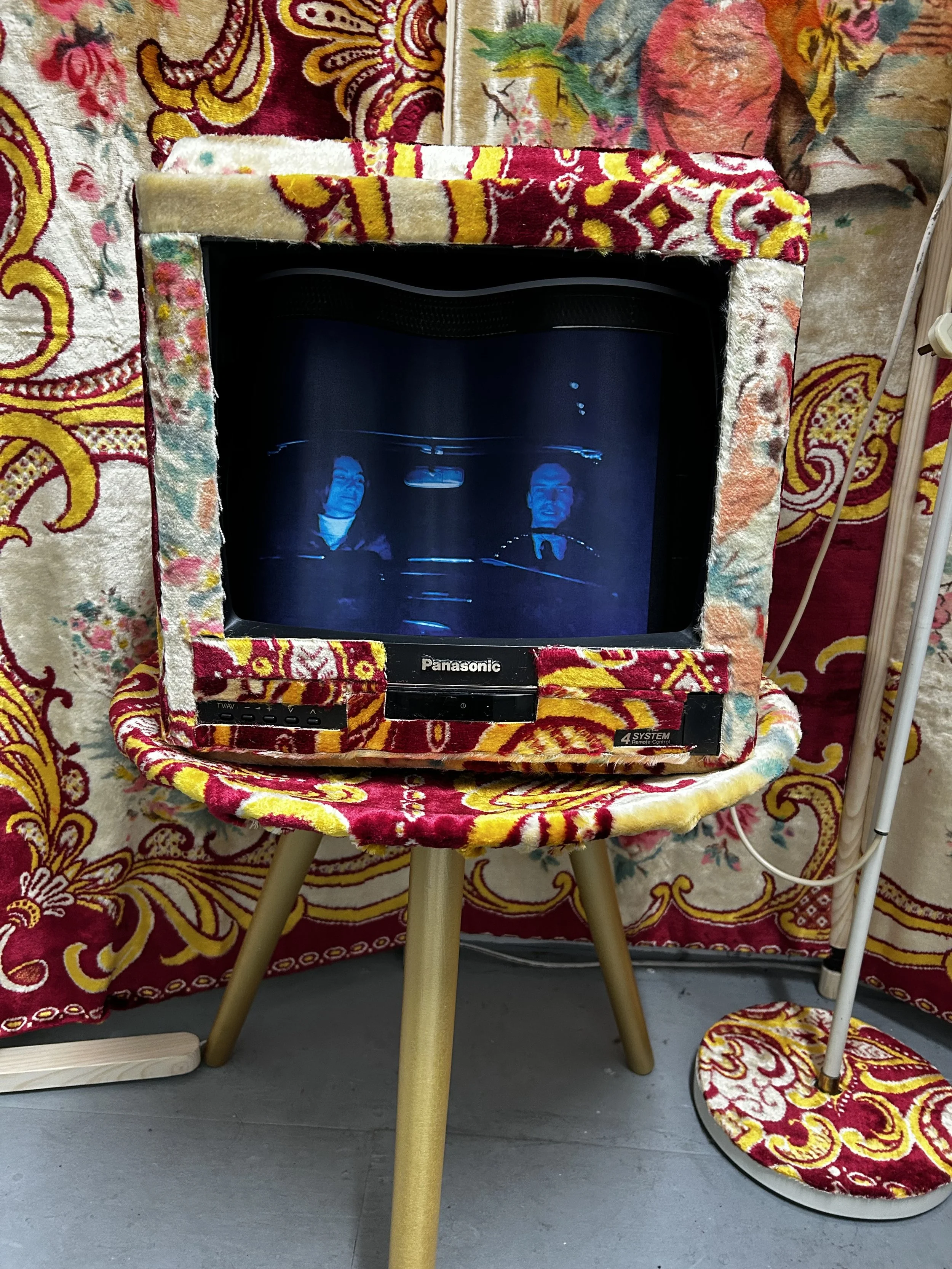
The Wedding Blanket, 2026, textile, table, lamp, screen, television, photocopied image insert), 130 x 150 x 45 cm (approx.). Installation view, 16 October 2026.
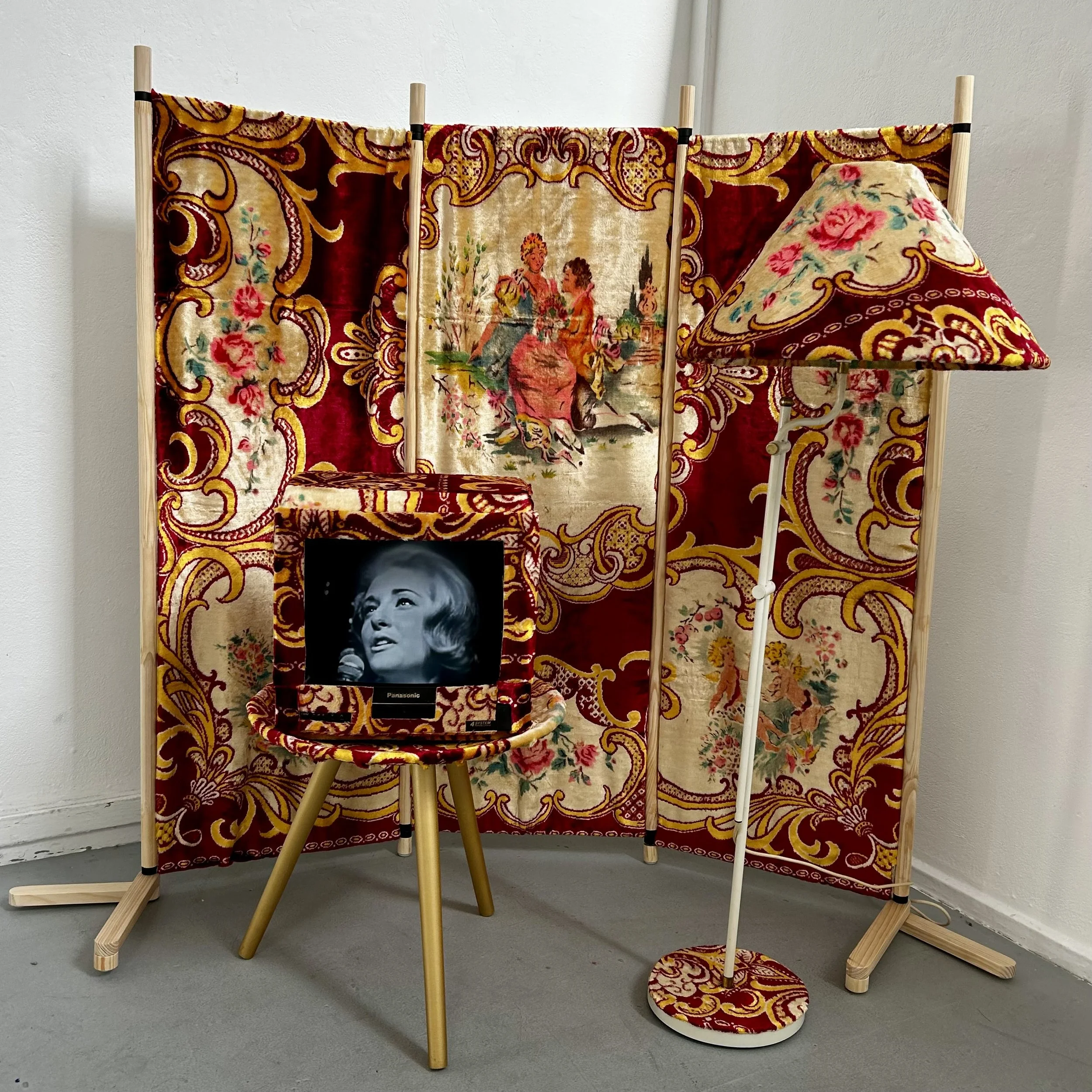
This work is a tableau showing a small domestic scene made up of a screen (room divider), small coffee table, CRT television, and floor lamp. All items are covered in a velvet blanket.
Regarding the blanket as a cultural artifact: Traditionally the velvet Italian wedding blanket was one of the most prized items in a bridal trousseau. Made of luscious, heavy, silk velvet and brocade, the blankets show Rococo style courting couples and cherubs (often after the French painter, Jean-Honore Fragonard). The custom was for the blanket to be laid out on the newly married couple’s bed to wish them fertility and prosperity.
The blankets were made in Italy and imported to Australia for the Italian migrant population - the examples found in Australia are from the 1950s-60s - these blankets were favoured by Greek migrants too who shared the same aesthetic and taste. Feminist analysis discusses them as serving as an anchor connecting women to their homeland as well as idealised projections of a woman’s status.
As well as researching the cultural context of the blanket, I undertook theoretical research to position the work in a framework that reflects my intentions.
It became apparent that it was the very materiality of the blanket that was the driver of the work. As I worked on this piece over the Semester, it occurred to me that I was responding to the blanket as subject not just as an object. I let it cover and ‘spread’ and often thought of it as an amoeba. It’s also very tactile, and I found myself patting and stroking it as I worked. The blanket is a thing, and as such, cannot act on us, but we can experience it as doing things; we can form alliances with it. This is what theorist Jane Bennett, writing about ‘Vibrant matter’ refers to as ‘the call of things.’
This project was inspired by the disruptive devices of dadaists, surrealists and new materialists who combine incongruous elements to create disturbing or comic scenarios. These works achieve what I wanted to test in my own work: they animate domestic objects by creating unexpected dialogues by contrasting technology, domesticity and historical eras. Further, they formed part of my research into feminist art broadly and the use of domestic imagery specifically.
In concept, this work began as a visual metaphor for the smothering and stifling effects of gender, ethnicity and patriarchy, and while still being this, it is also “active and expressive” as a tableau which expresses relations and meaning independent of language.